Home Podcast Learn with Laura Portfolio Blog
Contact
Laura’s Blog
Tips and tutorials to help you improve your website, blog, and email marketing
A good blog should include helpful links to other reputable sites. Why?
- Offering useful links positions you as the go-to source for excellent info on your topic. Readers who trust your link will come back for more.
- The owners of the sites you link to will often link back to you – or refer their readers to your site – a win-win for everyone.
- Search engines rank web pages based on the number of hyperlinks from other reputable websites that point to a web page. Link building is responsible for as much as 70% of a web page’s rank or position in the search engines!
Incoming links that come from high-quality websites provide much more “link juice” than links from low-quality or spammy websites.
Many of my readers have told me they’re unsure how to create a hyperlink. Here’s a tutorial to help you master the art of creating hyperlinks.
What NOT to do
I see a lot of websites and blogs that display a non-hyperlinked URL (web address), like this:
bloggingbistro.com
Impatient readers detest copying and pasting links, so let’s make it easy for them.
Create a Clickable Hyperlink
Step 1:
In your WordPress text editor (this method works in all website and blog systems), type or copy/paste your anchor text. The anchor text is the word, phrase, or sentence into which you will embed the hyperlink.
My sample anchor text:
The Ideal Length for a Blog Post
Step 2:
Copy the URL (web address) from your browser’s address bar, located at the top of your screen.
Quick Copying Hint: Triple-click anywhere inside the address to highlight the entire URL. Then click Ctrl + C to copy the URL (on a PC).
Step 3:
Paste the copied URL (Control + V) into your WordPress text editor. You don’t have to do this step, but if you’re new to hyperlinking and you want to see the URL for which you’re creating a hyperlink, go ahead. The URL should display the https:// at the beginning.
Step 4:
Highlight the anchor text by clicking and dragging over it or by triple clicking on the entire line:
Step 5:
Click the chain link icon in your blog’s toolbar (Insert/edit link)
 Step 6:
Paste the full URL into the URL field, as in the example below:
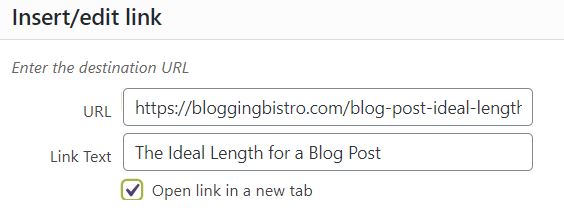 Click the gear icon to open link options. The anchor link text that you highlighted in Step 4 should display in the “Link Text” field. If it doesn’t, type your anchor text into the field.
Check the button that says “Open link in a new window/tab.” This makes it easy for the user to view the page you’re linking to without leaving your site.
Click the green “Update” button.
Your link will now look like this, with the hyperlink embedded inside the anchor text.
The Ideal Length for a Blog Post
When the user clicks the link, the linked page will open in a new window or tab. (If you pasted in the raw URL from Step 3 below your anchor text, delete it now.)
What to hyperlink
You can use this technique for linking to all sorts of things:
- Pages or blog posts on your own site
- Other people’s websites or specific pages on any public website
- Social networks
- Specific updates on social networks
- Images and graphics
Try it and let me know how it works for you.
Comments